Shyam Selvaraj · Counting the cost of complexity
The £5,000 Mistake: What Spouse Visa Refusal Costs in 2026
A spouse visa refusal doesn't just mean "try again." It means lost fees, months of delay, and paying everything twice. Here's the real cost breakdown.
Looking for step-by-step guides? Visit our immigration guides
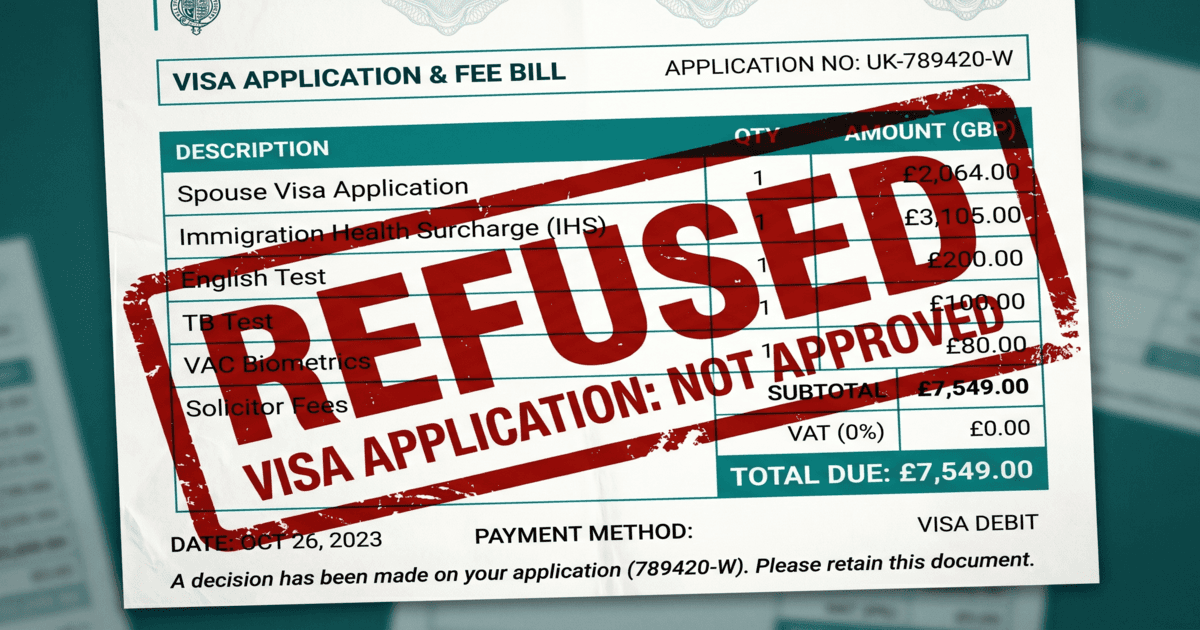
Table of Contents
The email nobody prepares for
There's a version of the spouse visa process that people imagine when they start. Gather the documents, fill in the form, pay the fee, attend the appointment, wait a few weeks. Sorted.
And then there's what actually happens when it goes wrong.
I've spent a lot of time reading through immigration forums, Facebook groups, and the questions people ask when they're deep in the process. The stories that stick with me aren't the successful applications. They're the ones where someone did everything they thought was right, spent thousands, waited months, and got a refusal letter. Not because they were trying to cheat the system. Because they misunderstood a rule, miscalculated their income, or missed a piece of evidence.
The financial hit is bigger than most people realise. And the knock-on effects go well beyond money.
What you actually pay before you know the answer
Let's start with the numbers. These are the current fees as of 8 April 2026, verified against gov.uk.
Key fact: The Home Office application fee for a UK spouse visa is £2,064 from outside the UK or £1,407 from inside the UK as of 8 April 2026. This fee is non-refundable if the application is refused.
If you're applying from outside the UK (which most first-time applicants are), you pay £2,064 for the application and £3,105 for the Immigration Health Surcharge, which covers 33 months of NHS access. That's £5,169 before you've booked the English language test, paid for a TB certificate, or translated a single document.
Add those up: £150 to £200 for the English test, £65 to £150 for the TB test (depending on the country), £50 to £80 for biometrics at the visa application centre, and potentially hundreds more for certified translations. If you've used a solicitor, add their fees too, which typically range from £1,000 to £3,000 for a spouse visa application.
A realistic total? Somewhere between £5,500 and £8,000. All paid before anyone at the Home Office has looked at your case.
What you lose when the answer is no
Here's what happens to that money when a spouse visa is refused.
The application fee is gone. £2,064 (or £1,407 if you applied in-country). The Home Office doesn't refund it. Doesn't matter why you were refused. Doesn't matter if the decision was wrong.
The IHS does come back, eventually. The Home Office refunds the health surcharge after a refusal, but there's a mandatory 14-day waiting period before they even start processing it. In practice, it can take several weeks to land back in your account. So while you haven't permanently lost £3,105, it's tied up and unavailable at exactly the moment you need it most.
Your English test and TB certificate may still be valid for a fresh application, depending on timing. But the fees are already spent. Same with translations, biometric appointments, and any professional help you paid for.
And here's the part that really stings. If you want to try again, you pay everything again. New application fee. New IHS payment. The clock resets.
Key fact: A refused spouse visa application followed by a fresh reapplication costs a minimum of £4,128 in non-refundable application fees alone (two lots of the £2,064 entry clearance fee), plus two IHS payments totalling £6,210, even though the first IHS is eventually refunded.
So the real cash flow exposure of getting it wrong and trying again is north of £10,000. For a couple whose combined household income needs to hit £29,000 just to qualify, that's not pocket change.
Why it happens
Home Office immigration statistics for recent years consistently show that roughly one in four or one in five family-related entry clearance visa applications are refused. The refusal rate for spouse and partner visas specifically varies by nationality and period, but these are not small numbers. Thousands of couples every year receive a letter that says no.
The reasons tend to cluster around a few areas.
The financial requirement catches the most people. The minimum income threshold is £29,000 per year for new applications. Roughly half of all employees in the UK earn less than this, according to ONS data. It's not just about earning enough, either. The rules about how you evidence that income are strict and specific. Appendix FM-SE sets out exactly which documents count, for which income categories, and for which time periods. Get one detail wrong and the caseworker may not consider that income at all. Self-employed applicants face an even more complex set of rules around how their income is calculated.
For a full breakdown, the financial requirement guide walks through the income categories in detail.
Relationship evidence is the second biggest issue. The Home Office needs to be satisfied that your relationship is genuine and subsisting. That means more than a marriage certificate. They want to see a pattern of communication, shared experiences, evidence of visits, plans for the future. Couples who've been in long-distance relationships often find this harder to demonstrate, not because their relationship isn't real, but because the evidence doesn't look the way caseworkers expect.
Documentation gaps and form errors trip up more people than you'd think. A date that doesn't match between your application form and your bank statement. A payslip that covers the wrong period. A missing employer letter. These aren't reasons anyone deserves to have their application refused, but they're reasons the Home Office uses. The evidence checklist guide covers exactly what documents you need and how to present them.
What happens next
Your refusal letter will tell you which options are available. Not every refusal comes with the same rights, so read it carefully. In broad terms, there are three routes.
Administrative review costs £80. You have 28 days to request one if you applied from outside the UK, or 14 days from inside. But the scope is narrow: it only checks whether the caseworker made a factual or procedural error. You can't submit new evidence. If the problem was a genuine shortfall in your application rather than a Home Office mistake, this probably won't help.
An appeal to the First-tier Tribunal costs £80 for a paper hearing or £140 for an oral hearing. Same deadline: 28 days (outside UK) or 14 days (inside UK). Appeals are decided by an independent immigration judge, not the Home Office, which makes them a stronger option when the refusal involved human rights considerations. But they take time. Six to twelve months is typical in 2026.
A fresh application has no time limit and lets you fix whatever went wrong. But you pay the full application fee and IHS again. And a previous refusal sits on your immigration record, which means the Home Office may scrutinise your next application more closely.
None of these options is quick. None is free. And all of them extend the period of separation, uncertainty, and stress that the refusal itself has already created.
The cost you can't put a number on
I haven't mentioned the part that actually matters most to the people going through this. The months. The distance. The conversations you have to have with your family about why it didn't work.
If you've applied from outside the UK, a refusal means you're still not in the UK. If your partner applied for an extension from inside the UK and it was refused, the situation is more complex and potentially more urgent. Either way, you're looking at months of additional waiting before your circumstances change.
And that's assuming you can reapply. If the refusal was on financial grounds and your income hasn't changed, you're stuck until it does. No amount of better paperwork fixes a genuine shortfall.
The one thing that's worth checking first
I'm not going to pretend that every refusal is avoidable. Some people genuinely don't meet the requirements and no amount of preparation changes that. If your income is £22,000 and you don't have savings to bridge the gap, the answer is the answer.
But a lot of refusals are avoidable. Particularly the ones that come down to whether you've correctly evidenced your financial position. People who earn enough get refused because their evidence was presented in the wrong format, or because they didn't understand which income category applies to their situation, or because they assumed savings would count without checking the calculation rules.
The financial requirement is the area where the gap between "actually qualifying" and "knowing whether you qualify" is widest. The rules around income categories (A through G), the savings calculation formula, the different treatment of employed versus self-employed income: these are genuinely confusing. I've written about how hard the spouse visa process is before, and the financial requirement is a big part of why.
AssessNow has an assessment that checks your financial position against the current Appendix FM rules and tells you where you stand. It costs £12.99. I'm not saying everyone needs it. If you earn £45,000 in a straightforward PAYE job and your payslips match your bank statements, you probably know the answer already. But if your income is anywhere near the £29,000 threshold, or you're combining income sources, or you're self-employed, or your partner's income needs to count too, it might be worth spending thirteen quid to find out before you spend five thousand.
The cost breakdown guide has the full picture of what the five-year spouse visa route costs end to end. Knowing what you're committing to financially, before you commit, isn't pessimism. It's preparation.
A note on how this article was written
AI tools were used to assist with research and fact-gathering for this article. The analysis, opinions, and conclusions are my own. Views expressed here are mine and do not represent the official position of AssessNow.
Frequently asked questions
How much does it cost if a UK spouse visa is refused?
Can I get my money back if my spouse visa is refused?
What are my options after a UK spouse visa refusal?
What is the most common reason for spouse visa refusals?
Can I reapply immediately after a spouse visa refusal?
Want to check your position?
Get a personalised eligibility assessment based on your specific circumstances. Instant results with a detailed report.
Browse AssessmentsImportant: This article is for informational purposes only and does not constitute legal advice. Immigration rules change frequently. For formal immigration advice, consult a qualified immigration solicitor or adviser regulated by the SRA or IAA.
Related articles
Spouse Visa Financial Requirement 2026: Complete Guide
Complete guide to the UK spouse visa financial requirement in 2026. Covers the £29,000 income threshold, savings rules, application fees, and everything you need to prepare.
Spouse Visa Evidence Checklist 2026: What Documents You Need
Complete checklist of documents needed for a UK spouse visa application in 2026, covering financial evidence, relationship proof, and supporting documents.
How Hard Is It to Get a UK Spouse Visa in 2026?
The UK spouse visa process is expensive, slow, and ranked second worst internationally. Here's what couples actually face and why the system needs to change.